
Introduction to Erweiterte Realität
In today’s rapidly evolving digital landscape, Erweiterte Realität stands at the forefront of technological innovation, fundamentally changing how we interact with the world around us. Unlike virtual reality, which creates entirely artificial environments, Erweiterte Realität enhances our physical reality by overlaying digital information—such as images, sounds, and 3D models—onto our real-world view through smartphones, tablets, or specialized AR glasses. This transformative technology is no longer confined to gaming and entertainment; it’s revolutionizing industries from healthcare to manufacturing, education to retail. As we explore the depths of Erweiterte Realität, you’ll discover how it bridges the gap between digital and physical realms, creating immersive experiences that enhance human capabilities and reshape our daily lives.
Understanding Erweiterte Realität
Erweiterte Realität represents a sophisticated blend of real-world and computer-generated elements that interact in real-time. At its core, this technology uses cameras, sensors, and algorithms to recognize and track physical objects, then superimposes relevant digital content that aligns perfectly with our perspective. The key differentiator from virtual reality is that Erweiterte Realität doesn’t replace reality—it enhances it, allowing users to remain connected to their physical environment while accessing additional layers of information.
The concept dates back to the 1960s, but modern Erweiterte Realität truly emerged with the advent of powerful mobile devices and advanced computer vision. Today’s AR systems typically rely on three fundamental components: a display device (smartphone screen, AR glasses, or heads-up display), tracking technology (GPS, accelerometers, gyroscopes), and software that processes environmental data to position virtual objects accurately. According to Wikipedia, this creates a seamless integration where digital augmentations appear anchored to real-world locations, responding naturally as users move through space.
The Technology Powering Erweiterte Realität
The magic behind Erweiterte Realität lies in its complex technological infrastructure. Modern AR systems employ simultaneous localization and mapping (SLAM) algorithms that continuously map the user’s environment while tracking their position within it. This allows virtual objects to remain stable and properly positioned even as the user moves. Advanced depth-sensing cameras and LiDAR technology on newer devices create detailed 3D maps of physical spaces, enabling more precise object occlusion and interaction.
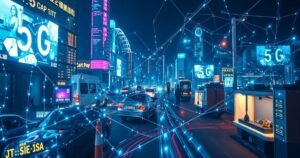
Processing power has become a critical enabler, with edge computing allowing complex AR calculations to happen locally on devices rather than in the cloud, reducing latency and improving responsiveness. Machine learning models now recognize objects, surfaces, and gestures with remarkable accuracy, making interactions more intuitive. The rise of 5G networks provides the high-speed, low-latency connectivity needed for shared AR experiences and cloud-based processing. For enterprise applications, Microsoft has developed specialized platforms like Azure Spatial Anchors that allow multiple users to share persistent AR experiences across devices.
Key Applications of Erweiterte Realität
Erweiterte Realität is transforming countless industries by providing innovative solutions to traditional challenges. In retail, customers can visualize furniture in their homes before purchasing, while in healthcare, surgeons use AR overlays to view critical patient data and anatomical structures during complex procedures. The education sector leverages Erweiterte Realität to create interactive learning experiences, bringing historical events to life or allowing students to explore 3D models of molecules and planets.
Key industry applications include:
- Manufacturing & Maintenance: Technicians receive step-by-step visual instructions overlaid on equipment, reducing errors and training time
- Real Estate: Virtual property tours allow potential buyers to walk through spaces and visualize renovations
- Navigation: AR-enhanced maps project directions onto live street views, making complex routes easier to follow
- Entertainment: Gaming experiences like Pokémon GO demonstrate the mass-market appeal of location-based AR
- Automotive: Heads-up displays project speed, navigation, and safety information onto windshields, keeping drivers’ eyes on the road
These applications show how Erweiterte Realität is moving beyond novelty into essential business tools that improve efficiency, safety, and user engagement.
Benefits of Implementing Erweiterte Realität
Organizations adopting Erweiterte Realität report significant advantages across multiple dimensions. The most immediate benefit is enhanced user engagement—AR experiences capture attention far more effectively than traditional media, leading to longer interaction times and deeper brand connection. For training and education, Erweiterte Realität enables hands-on learning without physical risks or resource consumption, allowing employees to practice complex procedures in safe, simulated environments.
The technology also drives substantial efficiency gains. Field service technicians equipped with AR glasses can access expert guidance remotely, reducing travel costs and resolution times by up to 40%. In retail, AR try-before-you-buy experiences have been shown to decrease return rates while increasing conversion. From a safety perspective, workers in hazardous environments receive real-time hazard alerts and procedural guidance overlaid on their field of view. For more insights on implementation strategies, explore our resources on emerging technologies.
Future Trends in Erweiterte Realität
The trajectory of Erweiterte Realität points toward increasingly sophisticated and seamless integration into daily life. The next frontier is lightweight, fashionable AR glasses that resemble traditional eyewear while providing powerful computing capabilities and all-day battery life. Companies are investing heavily in developing waveguide displays and micro-LED technology that will make these devices practical for mainstream adoption.
Artificial intelligence will play a crucial role in making AR content more contextually aware and personalized. Future systems will understand not just what objects are in view, but their function and relevance to the user’s current task, delivering proactive information. The emergence of WebAR allows AR experiences to run directly in web browsers without requiring dedicated apps, dramatically lowering adoption barriers. As spatial computing evolves, we’ll see persistent AR worlds that multiple users can interact with simultaneously, creating new forms of social and collaborative experiences. The potential applications seem limitless, from virtual meetings where participants appear as life-sized holograms to city-wide AR art installations.
Conclusion
Erweiterte Realität represents more than just a technological trend—it’s a fundamental shift in how humans interact with digital information and the physical world. As the technology matures and becomes more accessible, its impact will only deepen across every sector of society. Organizations that embrace Erweiterte Realität today position themselves at the cutting edge of innovation, ready to unlock new levels of productivity, creativity, and engagement. Whether you’re a developer, business leader, or curious consumer, understanding Erweiterte Realität is essential for navigating the future of digital transformation. To stay updated on the latest developments in this exciting field, visit here for continuous insights and analysis.